
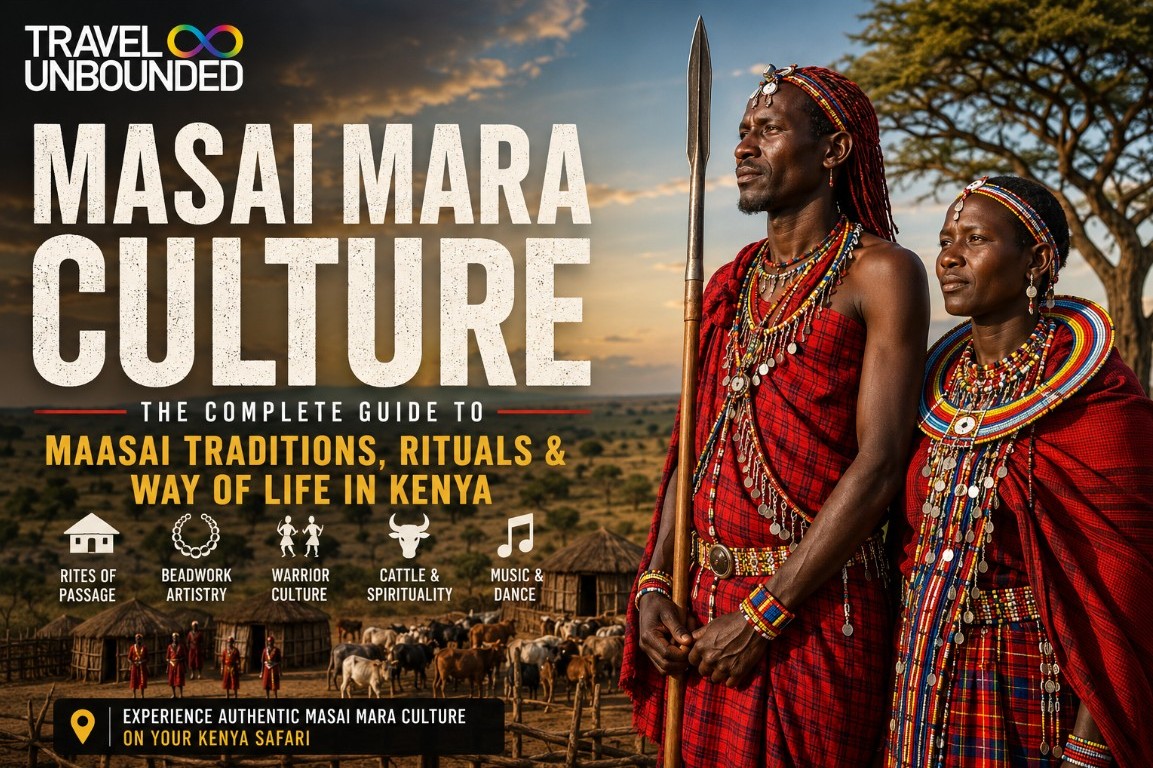
Masai Mara Culture: The Complete Guide to Maasai Traditions, Rituals and Way of Life in Kenya
Everything you need to know about the Maasai people, their sacred ceremonies, warrior customs, beadwork artistry, and how to experience authentic Masai Mara culture on your Kenya safari.
Masai Mara culture is one of the most extraordinary living traditions on earth. Stretching across the rolling savanna grasslands of southwestern Kenya, the Masai Mara is not merely a wildlife reserve — it is the ancestral homeland of the Maasai people, a semi-nomadic Nilotic community whose customs, ceremonies, and spiritual beliefs have endured for more than five centuries.
The name Maasai comes from the word Maa, meaning "people speaking Maa" — the Nilo-Saharan language at the heart of their identity. Their homeland spans southern Kenya and northern Tanzania, covering territories including the Masai Mara National Reserve, Amboseli, Laikipia, and neighboring conservancies. With an estimated population of close to 900,000 people across both countries, the Maasai tribe represents one of the most recognized and culturally rich indigenous communities in all of Africa.
Origins and History of the Maasai People
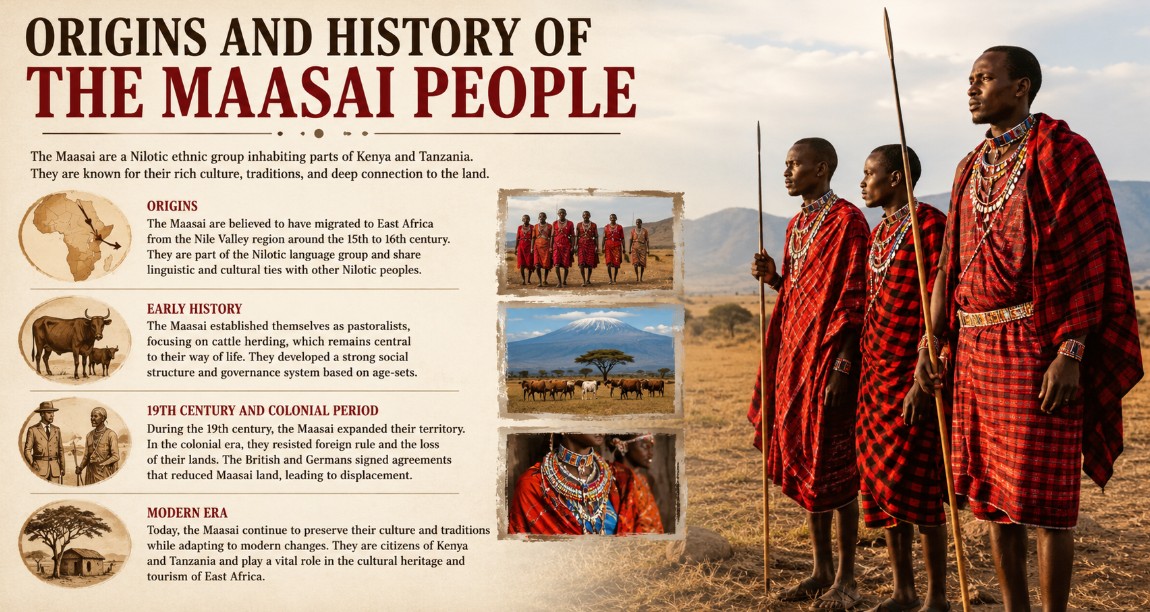
Historical depiction of the origins and migration of the Masai tribe in East Africa
Understanding Masai Mara culture requires going back to the origins of the Maasai tribe. Oral traditions and historical scholarship place the beginnings of the Maasai migration in the Nile Valley of South Sudan, from where their ancestors traveled southward over several centuries, reaching the fertile Great Rift Valley by roughly the 15th century. By the mid-19th century, Maasai territory had reached its greatest extent, stretching from what is now northern Kenya all the way down to central Tanzania.
The Maasai were historically feared warriors across the East African interior. Their resistance to both Arab slave traders and British colonial forces is well documented. Armed British troops who attempted to drive the Maasai from their lands in the early 20th century openly respected the courage and discipline of Maasai warriors. This fierce independence is a defining thread running through all aspects of Maasai traditions to this day.
From the 1940s onward, the Maasai lost significant portions of their ancestral lands to the creation of national parks and wildlife reserves, including Masai Mara, Amboseli, Serengeti, and Ngorongoro. Despite these pressures, the Maasai have maintained their pastoral, semi-nomadic way of life with remarkable cultural continuity. Today, Maasai landowners in the conservancies adjacent to the Masai Mara National Reserve lease their lands to safari operators as part of sustainable eco-tourism models that both protect wildlife and generate community income.
The Maasai Age-Set System: Foundation of Society
No aspect of Maasai culture Kenya travelers encounter is more structurally important than the age-set system, known as the olporror. All men circumcised within the same period — roughly every ten to fifteen years — belong to the same age group and advance collectively through life stages together, from junior warriors to senior warriors, then to junior elders and senior elders.
Senior elders hold decision-making authority and serve as the moral backbone of the community, while warriors known as Moran protect cattle and territory. Women operate within their own social framework defined through marriage and motherhood. Together, these systems create a deeply organized society in which every individual has a clear role, responsibility, and sense of belonging.
Enkipaata
The induction of boys aged 14–16 into pre-initiation status, preparing them psychologically and socially for warrior life. Held every 10 to 15 years at the formation of a new age set.
Eunoto
The transition of young warriors to senior status. The warrior's long ochre-coated hair is ceremonially shaved by his mother, and elders anoint him with milk and ochre.
Olng'esherr
The meat-eating ceremony marking the end of moranism and the beginning of elderhood. Men exchange the warrior's sword for the fimbo — the walking stick of the elders.
Maasai Rites of Passage: Sacred Transitions
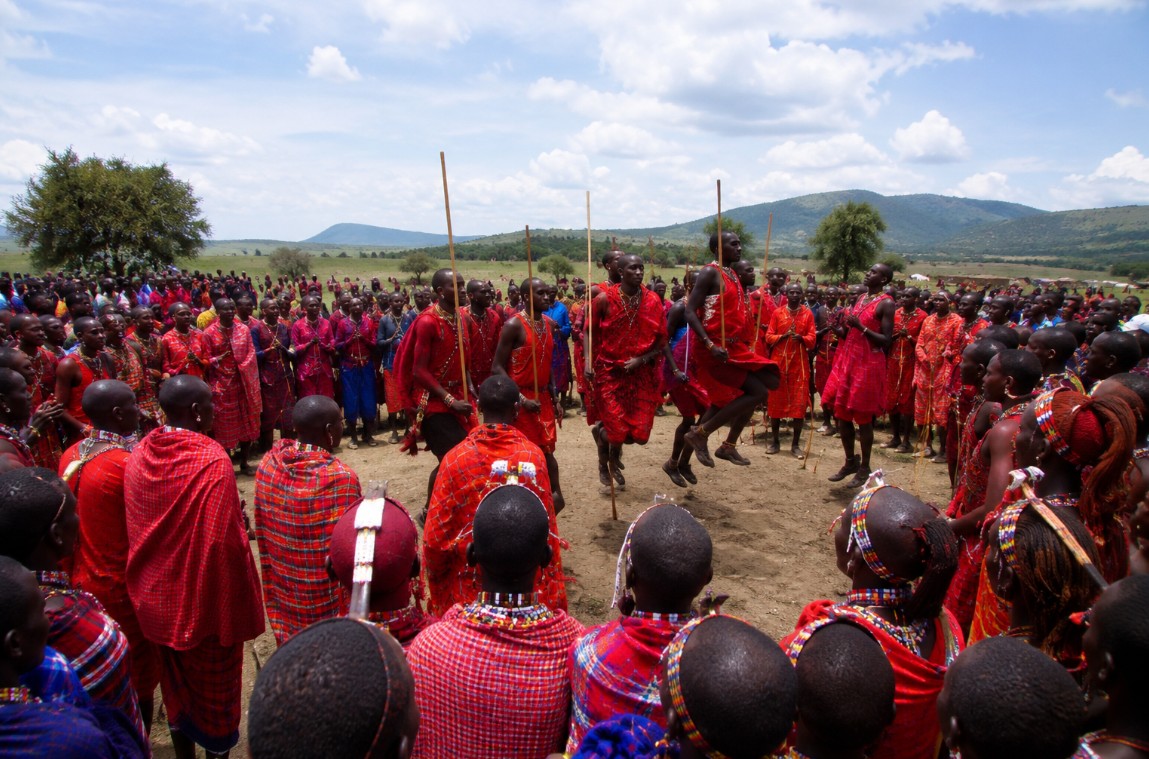
A Maasai community gathering - the rites of passage are large-scale celebrations bringing thousands together from across the region.
The rites of passage are the heartbeat of Maasai traditions. These are not private family events — they are large-scale communal celebrations that can bring together thousands of people from across wide regions, strengthening social ties, transmitting cultural values, and marking the cyclical renewal of Maasai society. In 2018, the three primary male rites of passage were inscribed on UNESCO's List of Intangible Cultural Heritage in Need of Urgent Safeguarding.
Enkipaata: The Gateway to Warriorhood
Enkipaata marks the formal induction of boys into the Maasai warrior system. Typically involving boys between fourteen and sixteen, its core purpose is to prepare them psychologically, socially, and spiritually for the demands of becoming a Moran. The ceremony involves extensive group travel across clan territories, communal singing, and instruction in the values and duties that define a Maasai warrior.
Emuratta: The Circumcision Ceremony
The circumcision ceremony, known as Emuratta, is widely considered the most vital rite of passage in Maasai society. Typically performed between the ages of fifteen and twenty, it represents a total psychological and spiritual rebirth. The ceremony is conducted publicly, and the initiate is expected to endure the procedure without showing any sign of pain — a demonstration of the courage required to serve as a warrior responsible for protecting the entire community.
Eunoto: The Warrior's Graduation
After approximately a decade of service as junior warriors, the Eunoto ceremony marks the most celebrated transition in a Maasai man's life. It features traditional guttural chants, single-file dances performed on one leg, and the Adumu high-jump competition. In a deeply moving central ritual, the warrior's mother ceremonially shaves his long ochre-coated hair, symbolizing the end of the carefree warrior phase and the assumption of elder responsibilities.
It is one of the biggest ceremonies we have in our life. We can never meet in such multitude. It unites the Maasai community entirely.
— Maasai Elder, Eunoto Ceremony
Olng'esherr: The Entry into Elderhood
The Olng'esherr meat-eating ceremony formally concludes the moranism phase and initiates men into the category of junior elders. As elders, Maasai men assume roles in community governance, dispute resolution, resource management, and the transmission of cultural knowledge to the next generation.
Maasai Clothing and Dress: Identity in Color and Cloth
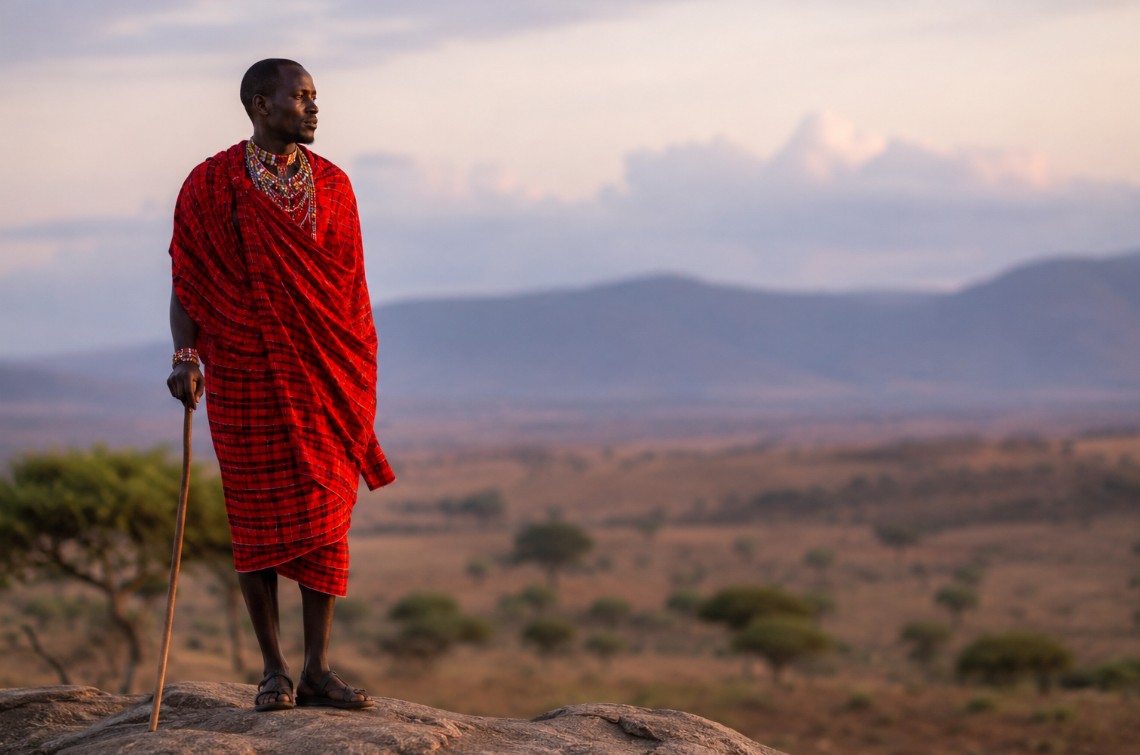
The iconic red Shuka — the sacred color of blood, courage, and unity that has defined Maasai dress for over five centuries.
The visual impact of Maasai dress is immediate and unforgettable. The iconic bright red robe known as the Shuka has become one of the most recognized garments on the African continent. It is a sheet of cloth wrapped around the body, typically one draped over each shoulder with a third layer worn over the top. While red is the most sacred color — representing blood, courage, and unity — Maasai men and women also wear blue, purple, and striped patterns depending on age, status, and occasion.
Young men who have recently completed circumcision wear distinctive black clothing during their transitional period. Women wear intricate metal hoops alongside elaborate beaded necklaces. Maasai warriors carry the rungu (a short wooden club) and the alasho (a long bladed sword). Body adornment includes ochre mixed with animal fat applied to the hair and skin, creating a distinctive reddish tint with both practical sun-protective and deep cultural significance.
Maasai Beadwork: A Living Language of Identity
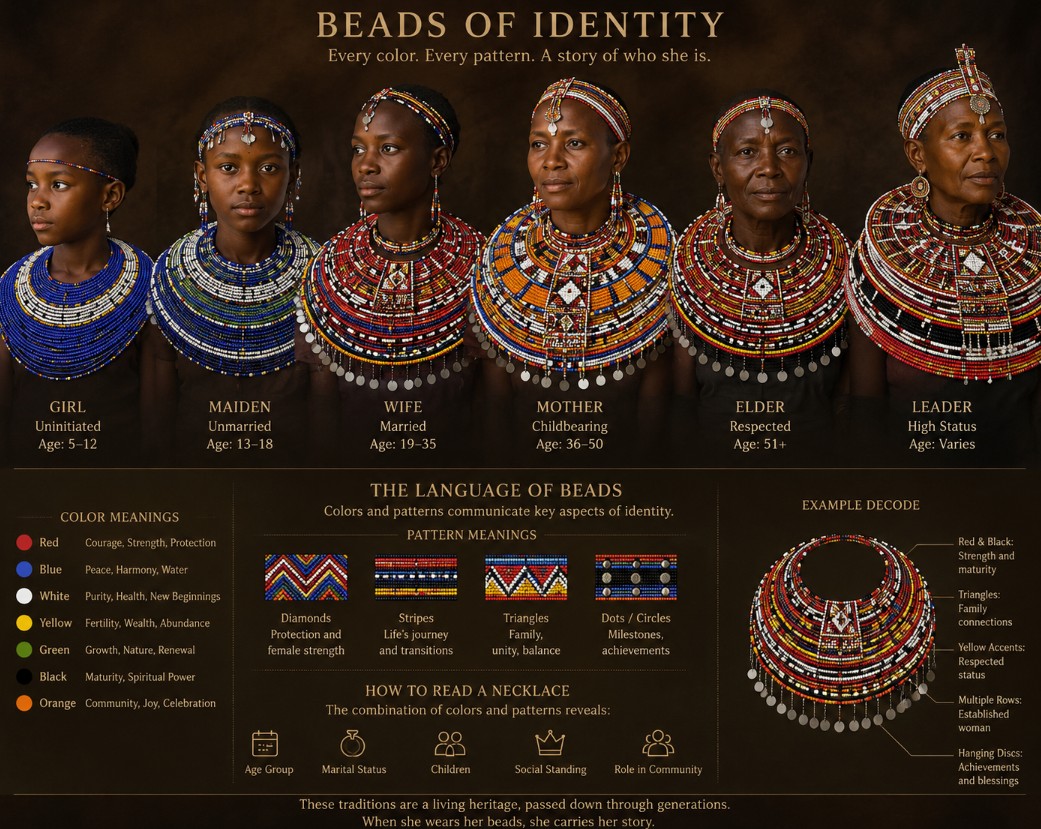
Elaborate beaded necklaces - each color and pattern communicates age, marital status, and social standing.
Among all the visual expressions of Maasai culture Kenya, beadwork is perhaps the most nuanced and communicative. Maasai beadwork is not decorative ornament — it is a complex visual language through which gender, age, marital status, social standing, and spiritual protection are communicated. It is primarily the domain of Maasai women, who create elaborate necklaces, bracelets, earrings, and body ornaments using glass beads, wire, and natural materials.
Each color carries precise meaning, consistent across communities and transmitted across generations through apprenticeship and practice:
Bead Color Meanings
Red / Orange
Bravery, strength, unity, and blood
White
Purity, peace, and cattle
Green
Health, land, and sustenance
Blue
Energy, sky, and water
Yellow / Gold
Fertility, the sun, and growth
Black
Hardship, solidarity, and harmony
The large flat disc-shaped beaded necklaces worn by women, called olkarsis, are among the most elaborate creations in Maasai artistry. Bridal adornments are particularly intricate, involving multiple layered necklaces, head pieces, and ornamental ear extensions that communicate the social significance of the marriage event.
The Manyatta Village: Architecture of Community
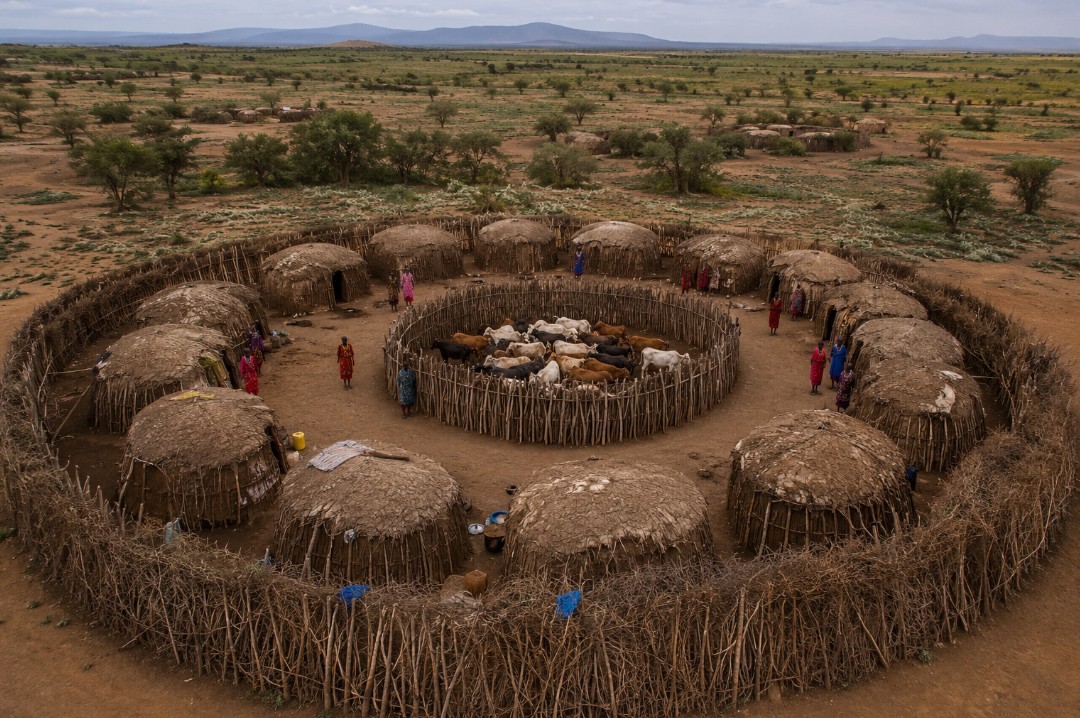
A traditional Maasai manyatta - built entirely by women, with the circular layout placing cattle at the protected heart of the community.
The physical center of Masai Mara culture is the manyatta, the traditional homestead. Each consists of multiple individual homes called bomas, arranged in a roughly circular pattern around a central cattle enclosure. The circular layout places the most precious asset - the cattle - at the protected heart of the community.
The construction of the boma is entirely the work of Maasai women. Each dwelling is built using locally available materials: a framework of wooden poles interwoven with smaller branches, then plastered with a mixture of mud, grass, cow dung, and ash. The resulting structure is a remarkably durable insulator against both the intense daytime heat and cool savanna nights. The average boma measures approximately three by five meters — a compact space in which an entire family cooks, eats, sleeps, socializes, and stores provisions.
The perimeter of the manyatta is enclosed by a thick fence of thorny acacia branches, creating an effective barrier against lions and other predators. Young warriors take turns standing guard through the night, rotating shifts to ensure the safety of cattle, women, children, and elders alike.
The Maasai are one of the few communities in East Africa that refused to participate in the slave trade, maintaining their autonomy through a combination of military strength, territorial control, and deeply held cultural values that defined identity through livestock and land rather than commodity trade.
Cattle, Religion, and Maasai Spiritual Life
In Maasai traditions, cattle occupy a position that is simultaneously economic, social, and sacred. Oral tradition holds that the supreme deity, known as Engai, gave all the cattle in the world to the Maasai at the time of creation — a belief that has historically underpinned their strong convictions regarding pastoral rights across East Africa.
Cattle are the primary measure of wealth. The Maasai diet traditionally revolves entirely around cattle products: milk, meat, and blood are the three primary food sources. Blood is typically mixed with milk and served as a high-energy drink, particularly during ceremonies and periods of physical recovery.
The Maasai believe in a single all-powerful god, Engai, who manifests in two forms: Engai Narok (the Black God — benevolent, associated with rain and blessings) and Engai Nanyokie (the Red God — associated with lightning and punishment). Religious practice is led by the Laibon, the spiritual leader and medicine man who mediates between the human and divine worlds.
Maasai Music and Dance: The Sound of the Savanna
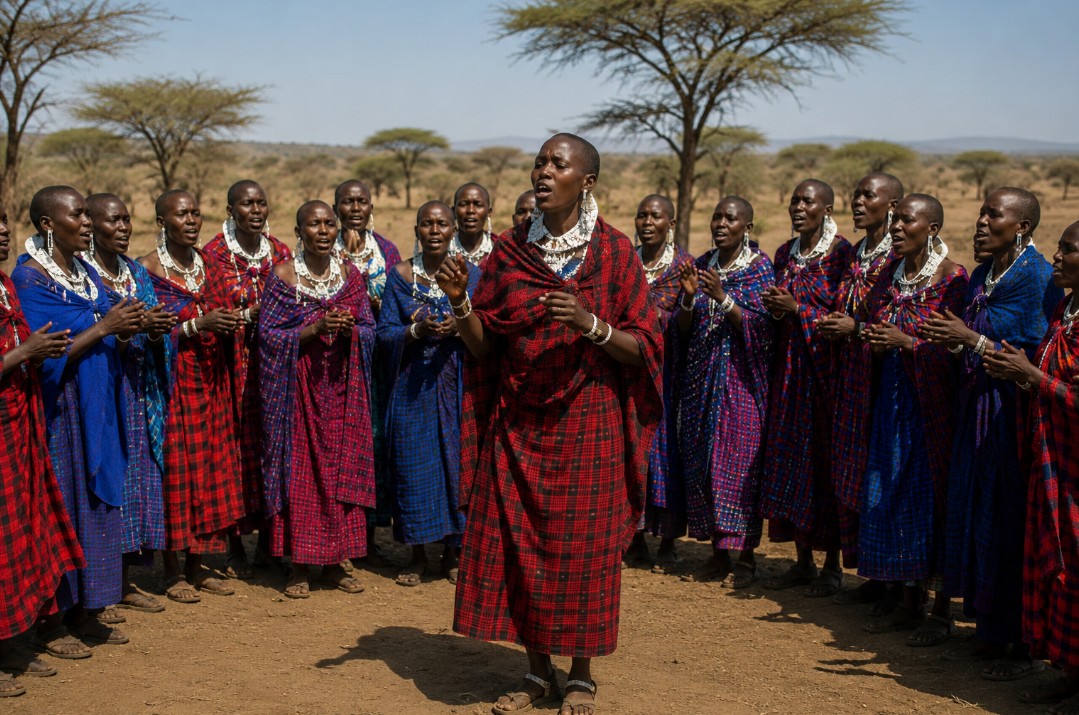
A Maasai cultural gathering — all music is entirely vocal, built from layered harmonies led by the olaranyani (song leader).
Music and dance are inseparable from every aspect of Maasai culture Kenya. What strikes first-time visitors most is that Maasai music contains no instruments. All music is entirely vocal, built from rhythms rendered by a chorus of voices singing layered harmonies while the olaranyani, the song leader, carries the melody. The olaranyani role shifts from song to song based on ability rather than fixed status.
The most widely recognized Maasai performance is the Adumu, the jumping dance. Warriors form a circle and take turns leaping as high as possible from a standing position, keeping their body perfectly straight. Women stand at the edge of the circle, their voices driving the energy of the ceremony. The beaded ornaments worn by both men and women create a percussive jingling sound that accompanies every movement.
Beyond the Adumu, Maasai singing encompasses lullabies, songs of praise for warriors and cattle, ceremonial chants specific to each rite of passage, and music used in healing rituals. All songs are transmitted entirely through oral tradition, memorized and passed down through community practice across generations.
Quick Reference: Masai Mara Culture at a Glance
| Cultural Element | Local Name | Meaning / Significance | Where You See It |
|---|---|---|---|
| Traditional Robe | Shuka | Identity and tribal affiliation; red is the sacred color of courage and unity | All daily and ceremonial contexts |
| Village / Homestead | Manyatta / Boma | Built by women; circular layout protects cattle at the core | Cultural village visits on safari |
| Jumping Dance | Adumu | Warrior competition demonstrating physical strength and endurance | Eunoto ceremony and cultural performances |
| Boy Induction | Enkipaata | Formal initiation of boys into the warrior age-set system | Community ceremonial events |
| Circumcision Ceremony | Emuratta | Most vital rite of passage; marks the transformation to warrior status | Community initiation events |
| Warrior Graduation | Eunoto | UNESCO-listed ceremony; mother shaves the son's hair | Every 7 years at clan level |
| Elderhood Ceremony | Olng'esherr | Meat-eating ceremony ending warrior life; UNESCO-listed | Community ceremonial gatherings |
| Spiritual Leader | Laibon | Medicine man and divine intermediary; guides community decisions | All major ceremonies and rituals |
| Warrior | Moran | Young men who protect the community and cattle; identified by ochre hair | Visible throughout Masai Mara villages |
| Beaded Necklace | Olkarsis | Visual language communicating age, marital status, and social standing | Cultural visits, market purchases |
| Deity / God | Engai / Enkai | Single supreme god; Engai Narok (benevolent) and Engai Nanyokie (vengeful) | Embedded in all spiritual practice |
| Song Leader | Olaranyani | Leads vocal music; role shifts by song based on ability | All communal music gatherings |
The Role of Maasai Women: Builders, Artisans, Cultural Keepers
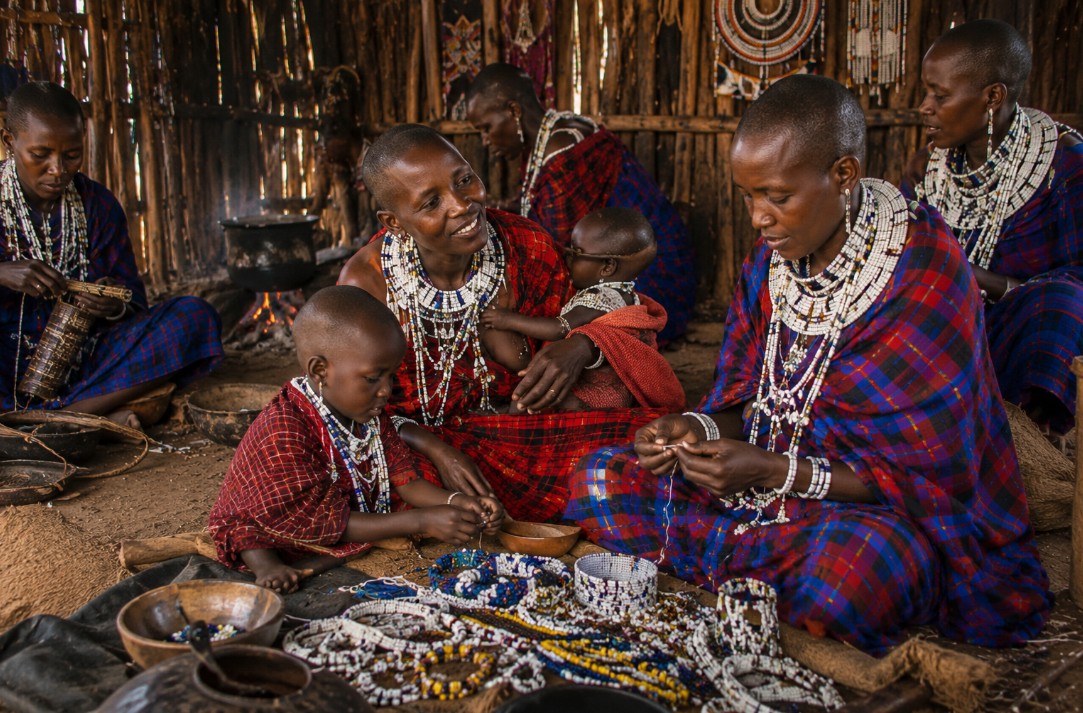
Maasai women are the structural foundation of the community - homebuilders, artisans, mothers, and carriers of oral tradition across generations.
Maasai women are the physical builders of the family home, the primary creators of beadwork, the principal managers of children and domestic provisions, and the carriers of oral tradition across generations. In a society often described in terms of male warrior culture, the women are the structural foundation on which the entire community rests.
During the Eunoto ceremony, it is the warrior's mother who performs the central act of shaving her son's hair — the most intimate and emotionally significant gesture in the entire ritual. Women's singing during the Adumu is not peripheral but integral to the event, their voices driving the energy of the ceremony.
In recent decades, Maasai women's cooperatives have emerged as important economic actors. Beadwork collectives allow women to sell their artisan products directly to visitors, generating independent income that contributes to household welfare, children's education, and community health programs.
Experiencing Maasai Culture on Your Kenya Safari
For travelers planning a Kenya safari culture experience that goes beyond wildlife, the Masai Mara offers one of the most authentic opportunities to engage with living African cultural heritage anywhere on the continent. Most safari lodges and camps offer guided visits to nearby Maasai villages as part of their guest programs, typically for an entrance fee of approximately USD 30 per person that goes directly to the community.
What to Expect During a Maasai Village Visit
A typical manyatta visit begins with a traditional welcome ceremony involving singing and the Adumu jumping dance. Guests are guided through the circular village by community members who explain the construction of the boma huts, the layout of the cattle enclosure, and the daily rhythms of family life. A curio market allows guests to purchase beaded jewelry, carved items, and traditional textiles directly from the artisans who made them.
Ethical and Respectful Cultural Engagement
Responsible engagement requires intentionality and respect. Photography should always be requested and is typically welcome once permission has been given and a modest fee agreed upon. Purchasing crafts directly from Maasai artisans rather than from intermediary markets ensures that income reaches the people whose skill and heritage are being celebrated. Choosing safari operators who have established long-term partnerships with Maasai communities makes a meaningful difference to both the quality of the experience and the wellbeing of the community.
Maasai Culture and Conservation: Guardians of the Ecosystem
The Masai Mara ecosystem - preserved in large part by the Maasai pastoral system, which has maintained open grassland corridors for centuries.
One of the most important dimensions of Masai Mara culture is its deep relationship with conservation. The Maasai have coexisted with the extraordinary wildlife of the East African savanna for centuries. Unlike many sedentary agricultural communities, the Maasai pastoral system has historically maintained vast open grassland corridors across which wildlife migrates freely. The Maasai cultural aversion to eating game meat meant they never hunted the wildlife they shared territory with, making them effective de facto stewards of the ecosystem.
In the conservancy model, Maasai families lease their communal land to responsible safari operators, receiving monthly payments per acre in return for an agreement to limit livestock grazing in designated zones. This provides communities with reliable income while expanding the effective wildlife range beyond the national reserve boundaries. Local Maasai are also employed as rangers, trackers, guides, and lodge staff — their generational knowledge of animal behavior and ecological relationships is an irreplaceable asset in wildlife monitoring and anti-poaching operations.
Maasai Culture in the Modern World
Contemporary Maasai traditions exist within a dynamic tension between preservation and adaptation. The Kenyan and Tanzanian governments have historically pressured Maasai communities to adopt sedentary lifestyles and integrate into the mainstream national economy. The Maasai have responded with characteristic resilience, selectively adopting useful modern tools — including mobile phones, motorcycles, and solar energy — while maintaining core cultural practices and values.
Today, many young Maasai men complete their moran phase and then pursue secondary or university education, returning to their communities as qualified professionals while still participating in age-set ceremonies. Maasai women's cooperatives have embraced social media to market their beadwork internationally, with pieces now sold to collectors and fashion houses around the globe.
The three male rites of passage inscribed on the UNESCO Intangible Cultural Heritage list in 2018 represent global acknowledgment that the Maasai ceremonial system is a form of living cultural heritage of significance to all of humanity — carrying both the responsibility and resources needed to ensure these traditions continue faithfully across future generations.
Plan Your Masai Mara Cultural Safari with Travel Unbounded
At Travel Unbounded, we have been crafting Kenya safari itineraries since 2014, with deep partnerships across the Masai Mara ecosystem and direct relationships with Maasai communities in the conservancies. Our Kenya safari culture packages combine the world's finest wildlife viewing with genuine, ethically structured Maasai cultural experiences that benefit the communities you visit.
Whether you are planning your first East Africa journey or returning to deepen a lifelong connection with the continent, our expert team will build an itinerary that includes authentic manyatta visits, the best wildlife corridors for the Great Migration, and accommodation options ranging from tented camps to luxury lodges — all within the heart of Masai Mara country.