
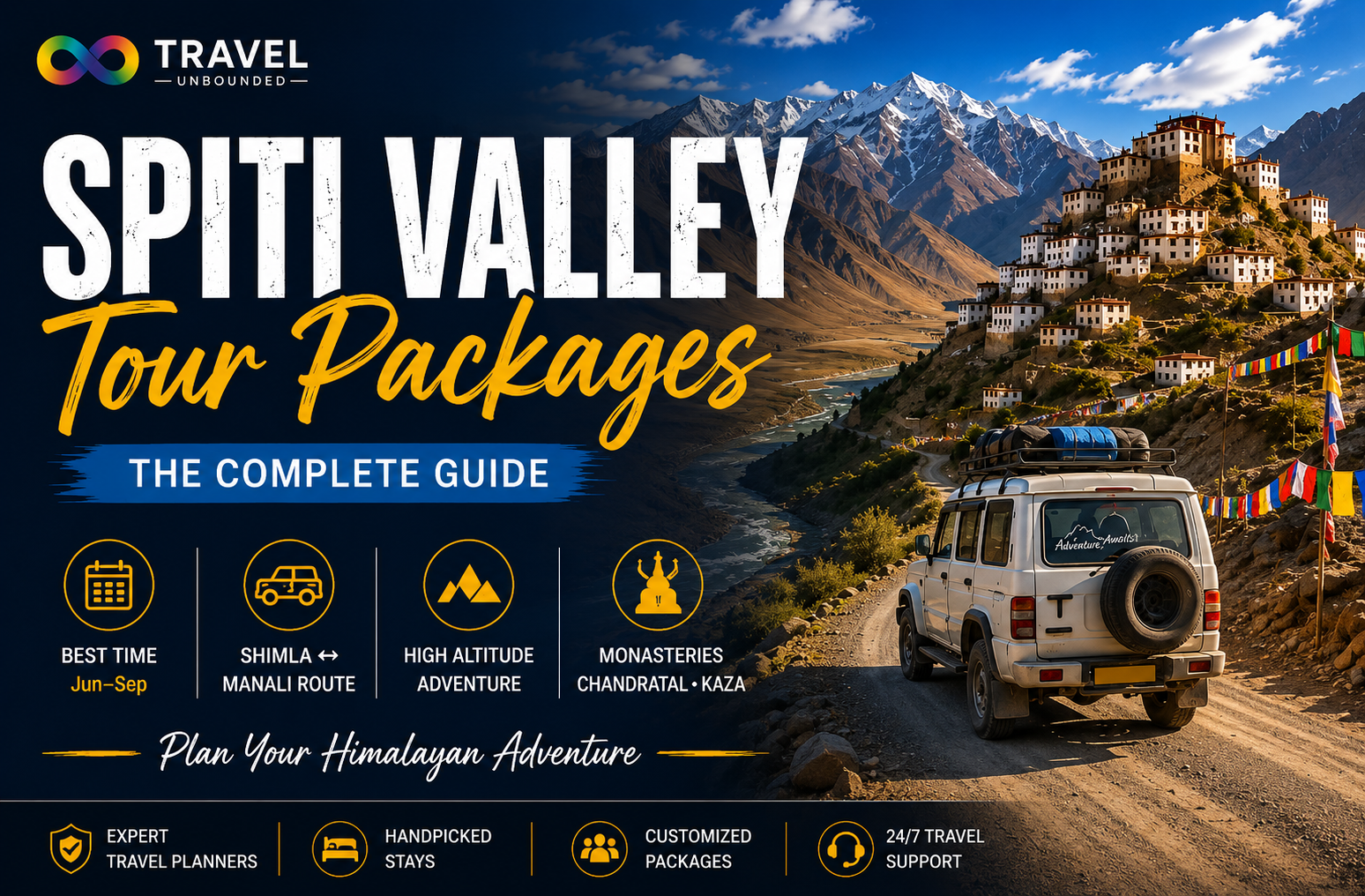
Spiti Valley Tour Packages: The Complete Guide
Spiti is one of the last great Himalayan road trips: a cold desert of blue skies, thousand-year-old monasteries, and villages perched above 4,000 metres. It is also remote, high, and seasonal, which makes planning matter more than it does on an easier holiday.
Good Spiti Valley tour packages take the guesswork out of the two routes, the short open season, and the altitude. This guide covers what they include, when to go, what they cost, a sample itinerary, the must-see stops, permits, and how to travel safely.
It is written for first-time visitors planning from anywhere in India, whether you book a group departure or a private trip.
Key takeaways
The full Shimla-to-Manali circuit is open roughly mid-June to mid-October
Indian citizens need no permit for the core Spiti circuit
Kaza sits at 3,800 metres, so acclimatisation is essential
Plan eight to ten days for a relaxed, safe trip
What do Spiti Valley tour packages include?
Most Spiti Valley tour packages bundle transport in a high-clearance SUV, hotels or homestays, breakfasts and dinners, a driver who knows the roads, and a planned circuit through Kaza, Key Monastery, and Chandratal. Private and shared group options both exist.
Inclusions vary, so read the fine print before you compare prices. A typical package covers:
SUV or tempo traveller transport across the whole circuit
Twin-sharing hotels and homestays with breakfast and dinner
A local driver and, on premium trips, a trip captain or guide
Permit paperwork where needed, especially for foreign travellers
Flights, lunches, monument entry tickets, and personal expenses usually sit outside the price, so add those to your budget before booking. A clear quote should also state the exact vehicle, the hotel category in each town, and how many people share the SUV.
What is the best time to visit Spiti Valley?
The best time to visit Spiti Valley is mid-June to September, when both routes are open, days are mild, and Chandratal is reachable. May and early June are quieter and cheaper, while winter is a hard, sub-zero adventure for experienced travellers only.
Timing decides which Spiti Valley tour packages are even possible, because the Manali route over Kunzum Pass only opens from late May or June once the snow clears. The table maps the year at a glance.
If you are also weighing the far north, our guide to the best time to visit Ladakh makes a useful comparison, since the seasons run in parallel.
Shimla or Manali: which route should you take?
Both lead to Kaza, and the best Spiti Valley road trip often uses one route each way. The Shimla route is longer but climbs gradually, which helps acclimatisation. The Manali route is shorter and more dramatic, but gains altitude fast over Kunzum Pass.
Entering from Shimla and exiting to Manali is the classic loop, since it eases you up to altitude and saves backtracking. Bikers who love this terrain often pair it with a Ladakh bike trip in the same short summer season.
Whichever way you go, keep the driving days shorter than they look on paper, because rough roads and altitude slow everything down.
How much does a Spiti trip cost?
A week-long trip is mid-range, and most Spiti Valley tour packages run from about 18,000 to 35,000 rupees per person for a shared group departure. Private trips, better hotels, and a Manali-Chandratal add-on push the total higher.
Shared group tours are the cheapest, private tours cost more
Homestays cost less than the handful of hotels in Kaza
Fuel, an SUV, and a Chandratal camp add to the total
Peak July and August rates sit above May and September prices
Costs also move with your start city, since reaching Shimla or Manali from Bengaluru or elsewhere adds flights and a night. Compare options on our Himachal tour packages page before you decide.
What does a classic Spiti Valley itinerary look like?
A classic Spiti Valley itinerary runs eight days as a loop, entering from Shimla and exiting to Manali. It climbs slowly through Kinnaur, spends three or four nights around Kaza for the main sights, and ends over Kunzum Pass at Chandratal.
Days 1 to 2: Shimla to Kalpa and Nako, gaining height gently
Day 3: Tabo monastery and Dhankar, then on into Kaza
Days 4 to 5: Key, Kibber, Langza, Hikkim, and Komic
Day 6: Pin Valley, with a rest day built in for altitude
Days 7 to 8: Kunzum Pass, a Chandratal camp, then Manali
Most Spiti Valley tour packages follow this shape, adjusting the number of nights to your pace, fitness, and how much time you have. Six-day versions skip Kinnaur and fly the Manali route both ways, which is faster but far more taxing on the body.
What are the must-see places in Spiti Valley?
The highlights cluster around Kaza. Key Monastery, the photogenic Chicham bridge, the fossil village of Langza, Hikkim’s high post office, and Komic’s hilltop gompa are the classics, with Chandratal and Tabo bookending the circuit.
Key Monastery: Spiti’s iconic hilltop gompa above the river
Chandratal: the crescent Lake of the Moon near Kunzum Pass
Langza, Hikkim, and Komic: fossils, a high post office, and a hilltop village
Tabo: a thousand-year-old monastery of ancient murals
Pin Valley: a green national park tucked off the main road
Leave time to simply sit in a village, share butter tea with a family, and watch the light change on the peaks, which is often the trip’s best memory.
Do you need permits for Spiti Valley?
Indian citizens do not need a permit for the core Spiti circuit, including Kaza, Key, Tabo, Pin Valley, and Chandratal. Foreign nationals need an Inner Line Permit for the Reckong Peo to Tabo stretch, issued at the Reckong Peo office on the Shimla side.
The gateway to Chandratal is Kunzum Pass, which the official Himachal Tourism board lists at 4,590 metres, with lakeside camps open only from June to October. Rules near the border can change, so confirm the latest requirements before you travel.
Some tour operators arrange foreign permits as part of the package, so ask upfront if anyone in your group holds a non-Indian passport.
How do you prepare for the altitude and journey?
Altitude is the real challenge, since Kaza sits at 3,800 metres and many sights climb past 4,000. Ascend slowly, take a rest day, hydrate well, and never rush from Manali to Kaza in a single push on your first day.
Build at least one full rest day early in the trip
Carry enough cash, since ATMs in Spiti are rare and unreliable
Pack warm layers even in summer, for the cold nights
Download offline maps, as mobile signal is patchy at best
Not sure your group is ready for the height? Talk to our Himalaya team about pacing the trip around children, older parents, or first-time high-altitude travellers.
Simple habits help too: eat light, avoid alcohol on arrival, and turn back or descend the moment symptoms get worse.
Frequently asked questions
Which is better, Spiti or Ladakh?
They are different, since Spiti is smaller, rawer, and quieter, with shorter drives, while Ladakh is bigger and more developed. Spiti suits travellers who want offbeat calm over famous sights.
How many days do you need for Spiti?
Plan eight to ten days for the full circuit. Shorter Spiti Valley tour packages of five or six days cover Kaza and nearby sights but skip the relaxed pace that altitude really needs.
Is Spiti safe for a first-time high-altitude trip?
Yes, with care. Choose the Shimla route for a gentler climb, build in rest days, and travel with an operator who paces the ascent and carries oxygen for emergencies.
Can you do a Spiti road trip by car or only by SUV?
An SUV with good ground clearance is strongly recommended, especially beyond Tabo and near Kunzum Pass. Hatchbacks manage in peak summer but struggle on rough, broken stretches.
What is the highest point on the trip?
Kunzum Pass at about 4,590 metres is the highest road point, with Komic among the highest motorable villages. Chandratal lake sits near 4,300 metres.
Is there mobile network and internet in Spiti?
Barely, since only postpaid connections work in parts of Spiti, and data is slow or absent in remote areas. Download maps and share your route with someone before you go.
Ready to plan your Spiti Valley trip?
Match the season, pick your route, and build in altitude days, and the rest is pure reward. We design Spiti Valley tour packages around your dates, pace, and budget, from shared group loops to fully private trips. Tell us your plan and we will send a tailored quote.