
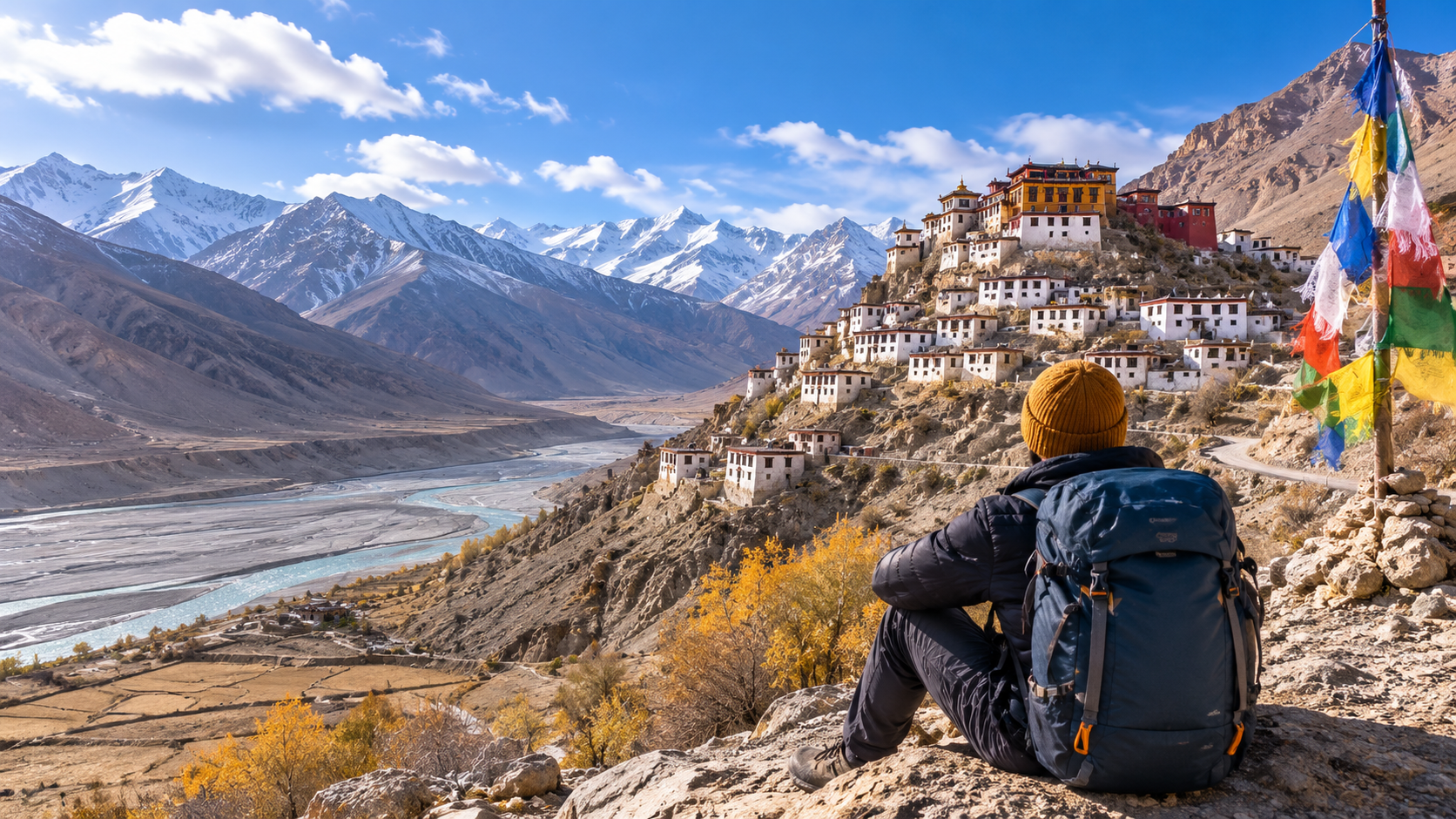
Spiti Valley Travel Guide 2026: Best Time, Route, Places & Budget
There's a reason Spiti keeps showing up on every serious traveller's bucket list right after Ladakh. It's not the easiest place to reach - the roads are rough, the air is thin, and network signal disappears for days - but that's exactly the point. Spiti is a cold desert tucked between the Himalayas and the Tibetan plateau, where 500-year-old monasteries sit above villages that still run on barley, yak, and silence.
If you've been putting off this trip because the planning feels overwhelming, here's everything you actually need - season by season, rupee by rupee.
Ready to start planning? Explore our Himachal trips or go straight to our Himachal Holiday package for a ready-built itinerary.
Where Exactly Is Spiti Valley?
Spiti Valley is a high-altitude district in Himachal Pradesh, bordering Tibet, sitting between 3,000 and 4,500 metres above sea level. Most trips are built around a circuit that connects Shimla, Kinnaur, and Spiti on one side, and Manali on the other - so you enter through one and exit through the other, rather than backtracking the same road twice.
Best Time to Visit Spiti Valley
June to September is peak season and the most reliable window - both the Shimla–Kinnaur and Manali–Kaza routes are open, weather is manageable, and every guesthouse in Kaza is running.
Late April to early May, right after the Manali road reopens for the season, is a quieter alternative - roads are freshly cleared, wildflowers are starting to bloom in the higher meadows, and you'll have monasteries mostly to yourself. Days are pleasant; nights are still cold.
October is the shoulder-season sweet spot for photographers — golden barley fields, thinning crowds, and clear mountain light — but the Manali route typically shuts by late October after the first heavy snowfall, so plan your exit through Shimla if you're travelling this late.
Winter (December–February) is for experienced, well-prepared travellers only. Spiti is accessible via the Shimla route even in winter, but temperatures can drop to -30°C and this is strictly not a first-timer's season.
Do Indian Travellers Need a Permit for Spiti Valley?
This is the question that trips up most first-timers, and the good news is simple: Indian citizens do not need an Inner Line Permit (ILP) for the standard Spiti circuit. What you do need is the mandatory online e-Aagman registration before entering the valley, plus registration at the Sumdo checkpost if you're entering from the Kinnaur side. If you're heading to Chandratal via the Manali side through Atal Tunnel and Koksar, your vehicle also needs to be registered through the same e-Aagman portal — this isn't a border permit, just a tourist-tracking system the district introduced to manage the post-Atal-Tunnel traffic surge.
(Foreign nationals need a separate Protected Area Permit for specific border-adjacent stretches — that's a different process entirely.)
How to Reach Spiti Valley
Shimla–Kinnaur–Kaza route: The classic entry point, with a gradual altitude gain that helps you acclimatise properly — this is why most first-time travellers are advised to enter via Shimla and exit via Manali, not the other way round.
Manali–Kaza route: Shorter on paper (~196 km) but rougher, crossing Kunzum Pass, and only open roughly June to October depending on snow. Early in the season, this stretch can take 10–12 hours of rough, unrepaired road; by late June or September, once things settle, that drops to 7–8 hours.
By air: The nearest airport is Bhuntar (Kullu-Manali), about 245 km from Kaza. Most travellers fly into Delhi or Chandigarh and drive up from there.
A Sample 7-Day Spiti Valley Itinerary
Day 1: Shimla to Kalpa/Sangla — enter Kinnaur, first taste of the mountains
Day 2: Kalpa to Nako — chortens, apple orchards, Nako Lake
Day 3: Nako to Kaza via Tabo — visit the 1,000-year-old Tabo Monastery
Day 4: Kaza local sightseeing — Key Monastery, Kibber, Chicham Bridge
Day 5: Kaza to Langza, Hikkim, Komic — fossils, the world's highest post office, and one of the highest motorable villages
Day 6: Kaza to Chandratal via Kunzum Pass — camp by the Moon Lake
Day 7: Chandratal to Manali — exit via Atal Tunnel
Ten to twelve days gives you real breathing room to add Pin Valley, Dhankar, or a short trek without rushing the acclimatisation days.
Prefer a trip that's already mapped out for you, with acclimatisation days and homestays sorted? See our Himachal Holiday itinerary.
What a Spiti Valley Trip Actually Costs
Budget varies a lot by season and travel style, but as a rough per-person, per-day estimate for 2026:
Budget backpacker: ₹2,000–3,000/day (homestays, shared transport, local food)
Mid-range: ₹4,000–7,000/day (guesthouses, private cab share, better meals)
Self-drive/bike trip with fuel, permits, and gear: varies widely — budget extra for fuel, since stations are sparse and spaced far apart along the circuit
Peak months (June–July) run more expensive across the board than the shoulder months of September–October, when accommodation rates ease and crowds thin out.
Places You Shouldn't Skip
Key Monastery — Spiti's largest and most iconic monastery, perched dramatically above the Spiti River
Chandratal Lake — the "Moon Lake" at 4,300m, a crescent of blue-green water that looks different at every hour of the day
Kibber and Chicham Bridge — one of Asia's highest suspension bridges, connecting two high-altitude villages
Langza, Hikkim, Komic — a fossil village, the world's highest post office, and one of the highest motorable villages on earth, all within a short drive of each other
Tabo Monastery — often called the "Ajanta of the Himalayas" for its centuries-old wall paintings
Pin Valley — quieter, less-visited, and home to some of Spiti's best trekking routes
Practical Tips Before You Go
Acclimatise properly. Spend your first day or two at a lower altitude before pushing on to Kaza, and watch for early signs of AMS — headache, nausea, breathlessness.
Carry cash. ATMs are scarce and unreliable once you're past Kalpa or Reckong Peo.
Check road status before you leave. Landslides and water crossings are common, especially early and late in the season.
Pack for a 30–40°C temperature swing in a single day — warm layers for early mornings and nights, even in peak summer.
Bring a power bank and offline maps. Network connectivity disappears for long stretches of the circuit.
A high-clearance SUV or a proper adventure bike (Royal Enfield Himalayan or equivalent) is the standard for the interior roads — a regular sedan will struggle badly once you're off the smoother Kinnaur stretch.
Is Spiti Valley Worth the Effort?
Yes — precisely because it isn't easy. Spiti rewards patience: the long drives, the cold mornings, the villages where the only sound is prayer flags in the wind. It's not a checklist destination. It's the kind of trip that changes how you think about a "vacation" altogether.
If you're building your Spiti itinerary and want the acclimatisation schedule, road conditions, and homestays already figured out for you, that's exactly the kind of planning we handle. Browse all our Himachal trips or head straight to the Himachal Holiday package to see a complete, ready-to-book itinerary.